I’ve been following Zach’s Gear Garage channel and really appreciate the knowledge and experience he shares with the whitewater community.
After listening to Zach explain his approach to organizing a river rescue, I came up with an acronym to help remember the key steps when things go wrong on the water.
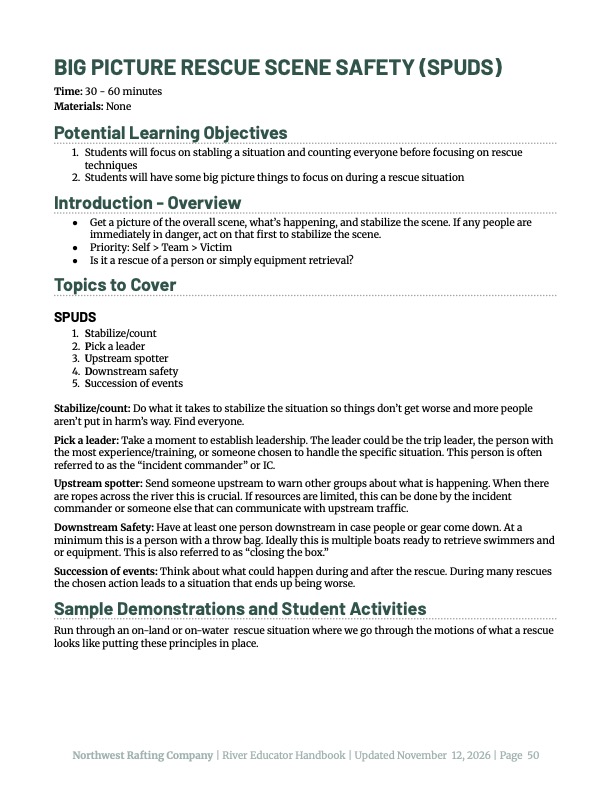
S.L.U.D.E.
- S – Stabilize & Count
- L – Leadership Established
- U – Upstream Spotter
- D – Downstream Safety
- E – Evaluate What Happens After
The idea is to have something simple that’s easy to remember, especially in a stressful situation when clear thinking and organization are critical.
All credit to Zach for sharing the rescue principles. I just wanted to put them into a format that’s easy to remember and hopefully useful to other boaters.
Think about elite military units like Navy SEALs or Delta Force. These guys train constantly, but even they understand that when adrenaline is pumping and things go sideways, it’s easy to forget important steps.
That’s why the military uses acronyms like MARCH, to remember priorities when treating serious injuries, and GOTWA, to remember the key parts of a contingency plan when teams separate.
It’s not because these guys don’t know what they’re doing. It’s because they understand how the brain works under extreme stress. An acronym gives them something simple to fall back on when everything around them is chaotic.
And that’s exactly why I like S.L.U.D.E. It’s not about changing what you’re teaching. It’s about giving people a simple way to recall what they’ve already learned.
When an accident happens on the river, someone might know all five principles but struggle to remember them in the heat of the moment. Having one familiar word could help trigger those critical steps.
If some of the most highly trained people in the world use acronyms to help recall critical procedures under pressure, why wouldn’t we apply that same thinking to river safety?
The acronym doesn’t replace the training. It helps make the training accessible when it matters most.
Acronyms help lots of people remember things. I remember learning ELLBUMGATUKTKr in 8th grade geography class. What does it mean you might ask? some Eastern Europe and Central Asia countries.
When acronyms are fun/funny/words we might use lots it’s a great way to remember information. I think S.LU.D.E. is maybe a little easier to remember that S.E.S.S.T (Zach’s version) and could work for some people.
I second all the comments on using acronyms. I have use them for technical systems, operational responses and medical evaluations. They help keep me focussed and on track when things are crazy during rescues.
Last spring I took a rescue class with Zack and was introduced to L.U.D.E, which he later added “S” to and really liked it. I incorporated it into an SRT class I taught last July and all the participants quickly latched onto it, which was evident during various scenarios used it in.
Acronyms are just tools to use to remember how to do something right…just like tying knots. I have seen a dozen different ways to tie a bowline. Which way someone uses doesn’t really matter…as long as it is tied correctly at the end. Same with doing a medical focus survey, medical history, or setting up the correct response to a rescue on the river. Find a way that works for you, that organizes your thought processes, is consistent and gets the job done.